
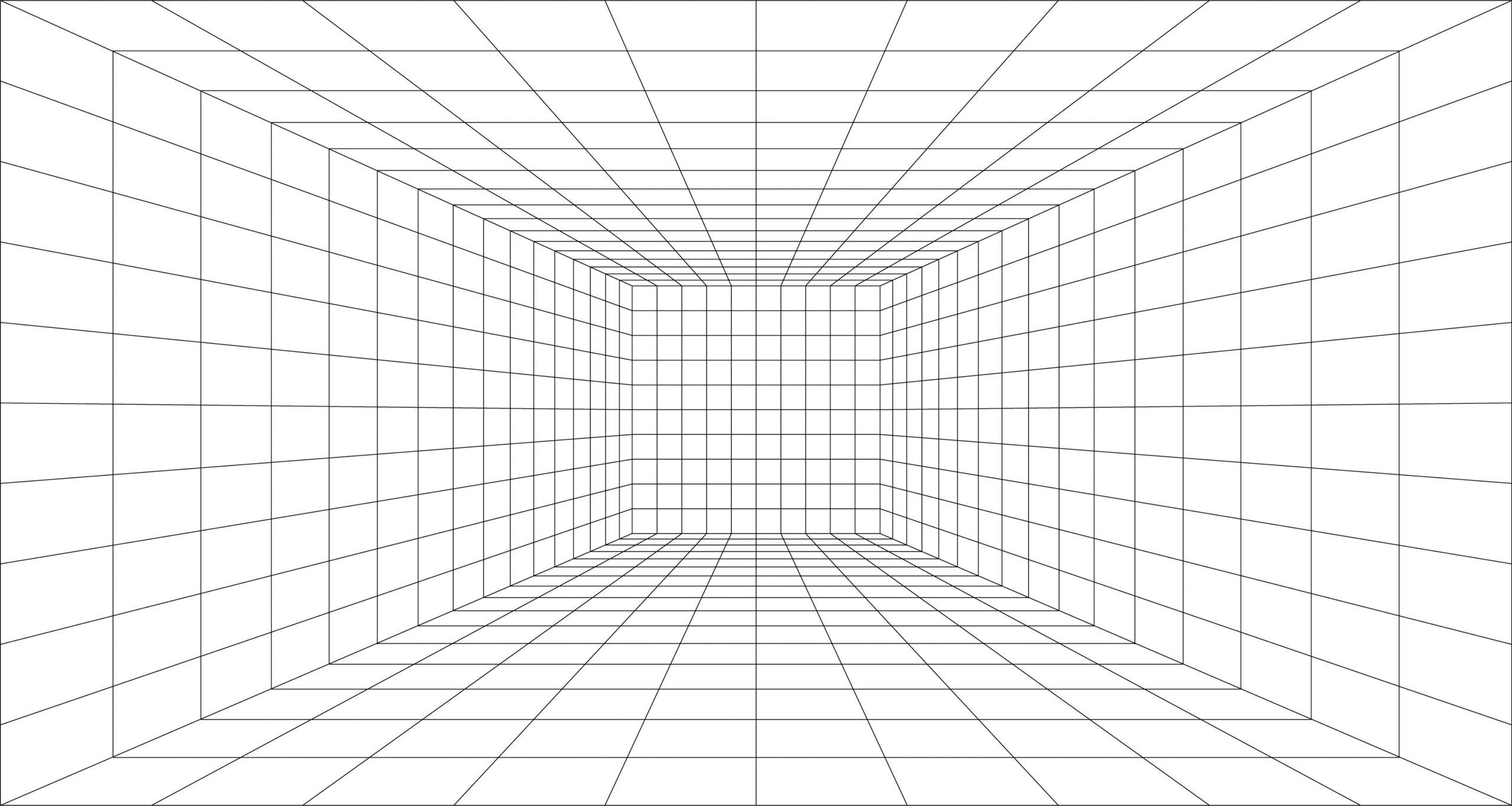
GETTING A HANDLE ON PERSPECTIVE
by Morgan Riekert
In this article on drawing basics we will be dealing with one of the more technical and perhaps harder to grasp principals of drawing, namely, Perspective. It is vitally important in any drawing or painting where you are trying to capture a representation of a three-dimensional space or object on your page / canvas in a realistic or believable manner.Stretching paper over a canvas.
It is important to realise that perspective does not just apply to the obvious scenes like landscapes or city scenes, where you may for example need to line up all the buildings proceeding down a street to a single vanishing point. But that it is equally important, although sometimes less obvious in still life and figure drawing, where it is more commonly referred to as foreshortening.
This basic principal is that all objects will appear smaller the further away they are from the viewer. Remembering this basic principal can help to make the subject of perspective easily manageable for most but there is a lot more to take into consideration to get it completely right.
Firstly lets have a look at the VIEW POINT. Think about looking at a scene or object you want to draw through a camera view finder. One step to the left and all your angels and objects sift in relation to each other and in themselves. A box for example, viewed directly straight on might as well be a flat square. One step to the left, up or right and you create a whole different aspect of the same object with a whole lot more depth. This is why in creating depth in our drawings we need to consider the optimal view point where we can take advantage of the shapes created by perspective and how one object in the scene relates to the others.
The next thing to look for is the HORIZON LINE. Imagine a line at your eye level running horizontally through the scene you are looking at now, this is the horizon line. If you change your position ie. stand up or sit down the horizon line moves with your eye level. However if you glance up or down the horizon line does not move because your head and eye level have stayed the same. The horizon line is the basis for constructing perspective. Any objects or shapes above the horizon line slope down towards it and anything below will slope upwards to it.
Next comes the VANISHING POINT, which is housed on the horizon line in both one and two point perspective. The vanishing point is the point where the vanishing lines of any given object will seemingly meet on the horizon line.
Now that we’ve got the basics lets look at the three different types of perspective.
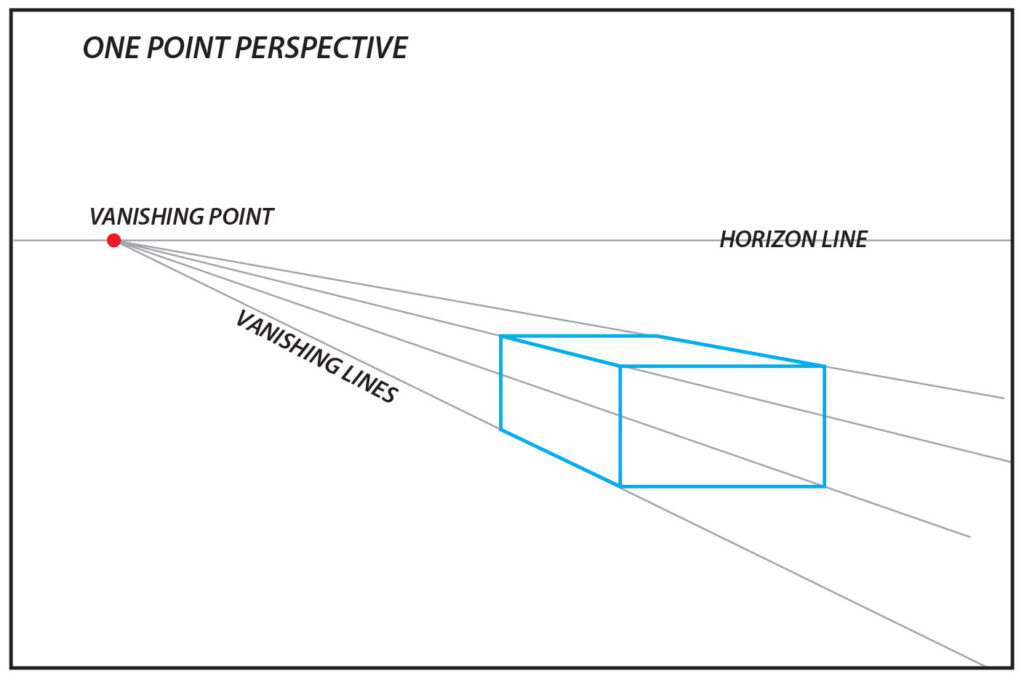
ONE POINT Perspective.
One point perspective is used when you are viewing an object or space face on. Which means the lines will be either parallel to the horizon line or directly perpendicular to the horizon line and thus meet at the vanishing point. It is quite simple to construct, and it gives the viewer a simple and straightforward line of sight which is great for retaining clarity giving your drawing an obvious focal point.
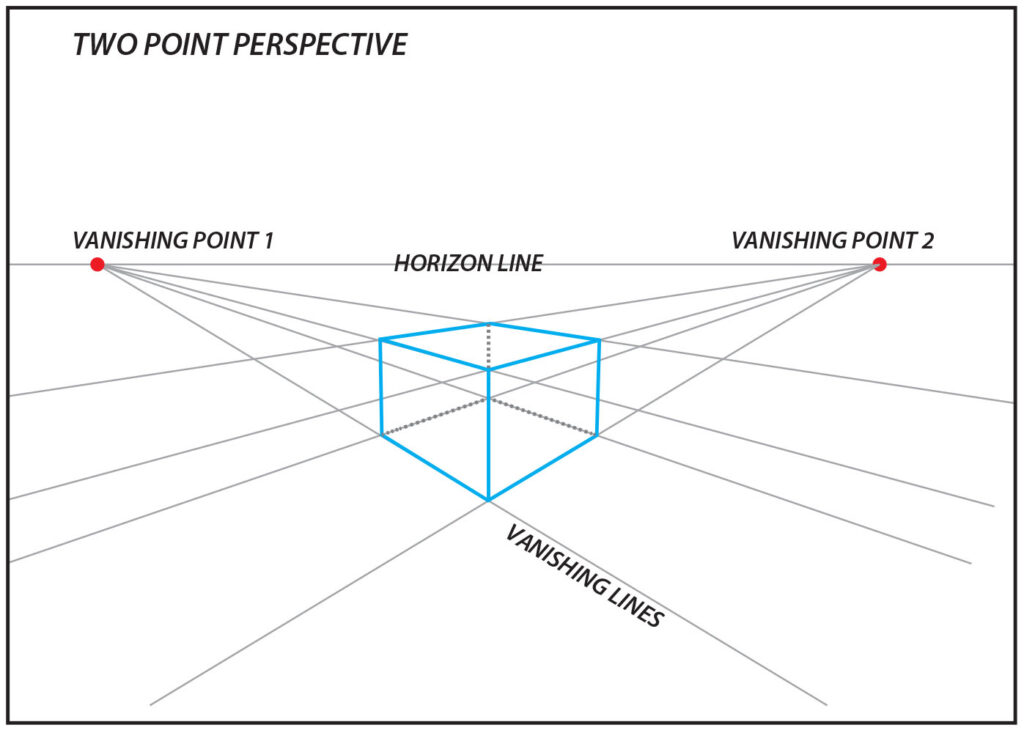
TWO POINT Perspective.
This is when your object or space is at an angle to the horizon line. Thus you are not looking directly at the front part of the object but rather at a corner of the object. With no lines parallel to the horizon line you will need two vanishing points to construct the object.
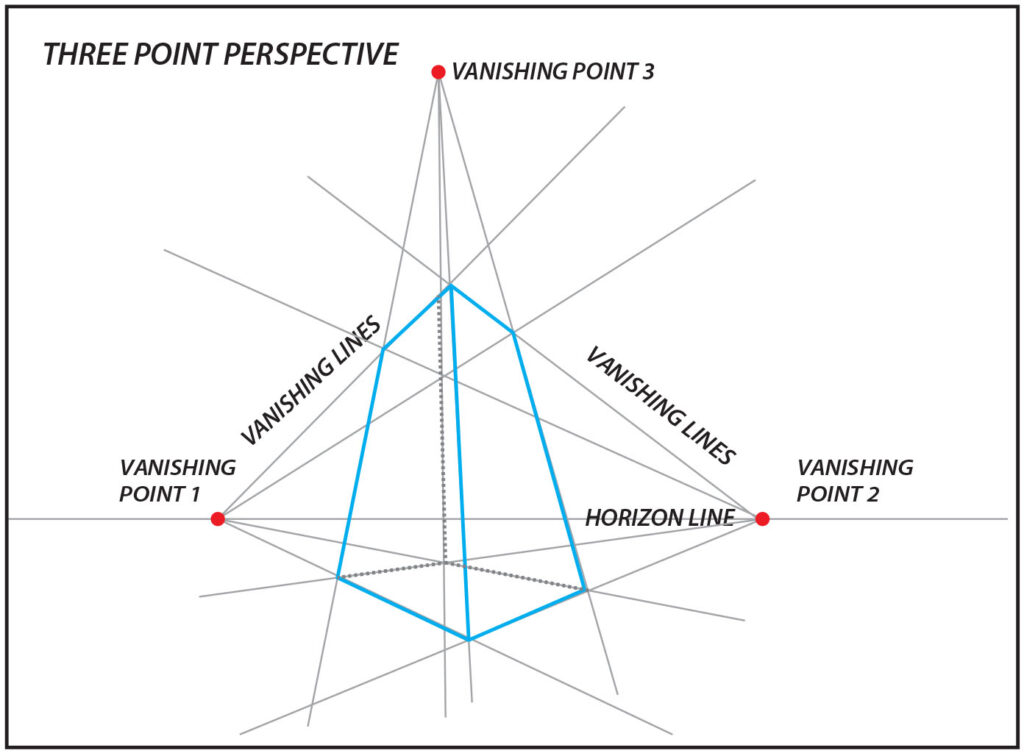
THREE POINT Perspective.
Quite simply this is the same as two point, except for the fact that you are adding a third vanishing point to account for the height of the object. The third vanishing point does however not fall on the horizon line but will be either above or below the object depending on the vantage point. If you are looking up at the object it will be above and if you are looking down on the object it will be below.
As far as applying this information to your drawing: it is not necessary to construct a multitude of vectors and blue prints under all your drawings but rather to have a good understanding of the principles of perspective so that firstly you know what to look for and secondly you can understand why the angles and lines that you can see are doing what they are doing. If you know how and why you will be able to translate what you see onto your page.
In short the more you become aware of the ever present optical force of perspective the more instinctive it will become for you to construct what you see without all the working out and guidelines and perhaps more importantly the keener your eyes will become at spotting where it looks amiss.