

SELECTING PRINT PAPER
By Randal Scott, the proprietor of Fine Art Papers, importers and suppliers of fine art and conservation papers throughout New Zealand and the South Pacific.
The day I learned how important the specific characteristics of papers are to the creative process, I made it my business to find out why a smooth hard paper is needed for lithography; why heavily sized paper is preferable for drawing; why soft, supple papers are best for intaglio printing; and why a heavy, textured paper works best for pastel. I knew I had to pay more attention to the way a particular paper influenced the final appearance of drawings, prints, and paintings.
Printmaking papers are not just for print-making. Some printmaking papers have become favourites for drawing or mixed media techniques. The distinguishing feature of a good printmaking paper is its ability to take a soaking, to absorb a lot of ink, often with multiple runs through a press, without disintegrating or deforming.
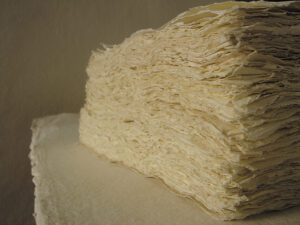
 Fine printmaking papers are made with an archival fibre source, which in the European print-making tradition is usually cotton. Japanese papers are often made with kozo (pure mulberry cellulose), another durable and archival fibre.
Sparkle
Both print-making and watercolour papers are made uniformly flat by passing them through a press. Sometimes this will involve the paper being passed through rollers, which imparts a surface finish. These may vary from very smooth (hot pressed), velour (cold pressed) , to a rough surface. Hot pressed is not suited for transparent colours in watercolour, but is an excellent surface for screen-printing, lithography and many other printing techniques. The coarser surfaces can provide sparkle and liveliness.
Dampen
Some techniques, such as intaglio printing, require that the paper is dampened or soaked so that the fibres are pliable enough to find contact with the inked depressions of the plate. The length of time a particular paper should be soaked or dampened depends on the amount of sizing the paper contains. (Ask your supplier for samples so you can test soak these for yourself). Some types of relief printing with oil-based inks (woodcuts, block-printing etc) may also benefit from a light surface wipe with a damp cloth just prior to printing if your paper of choice is a heavily sized watercolour paper such as Arches Aquarelle.
Preparation
When soaking for etching it is advisable to prepare your paper the night before printing. This allows enough time for the paper to absorb the moisture fully. You can use a plastic sheet that is larger than the paper; this ensures when folded and sealed no air is able to get in and dry the dampened paper.
Step 1. Decide the dimensions and how many sheets of print-making paper are required for either proofing or the edition.
Step 2. Start by filling a clean water tray up with enough water to dip and roll a sheet of print-making paper with one motion from top to bottom or left to right then drip off the excess water until there are very few drips falling from one corner. Take the paper and lay it face down, on one side of the open sheet of plastic.
Step 3. Take the next sheet of printmaking paper and lay it face down on top of the dampened paper. This sheet acts as a blotter in between the wet sheets to absorb the excess water.
Step 4. Take the third sheet and roll it through the water and drip off the excess water as you did for the 1st sheet of printmaking paper and stack it face down.
Step 5. Repeat steps 2-4 ending with a dampened sheet of paper.
Step 6. Fold the plastic sheet over the paper with a neat fold along the edge of the paper. Fold the edges in. You may need to use tape to seal the edges but if your plastic is heavy enough just flip the plastic over so the folds are underneath. This will prevent air getting in over night.
Step 7. Make sure after removing a sheet of paper for printing that you reseal the plastic between prints to make sure the paper does not dry out during the day.
 Weight
Papers for printmaking and watercolour are usually made in weights between 180gsm and 600gsm, the standard for print-making being 200gsm to 350gsm. In the case of watercolour paper under 356gsm soaking will be required to prevent the sheet from buckling as you paint.
Most artistís paper of today are mould-made and run through a series of rollers before being converted to single sheets. This process creates a directional pull and results in a ëgrainí, which means the paper, may tend to stretch more in that direction. For screen-printing multiple colours and for multiple passes through the etching press, it is advantageous to print on the ëcross grainí orientation. The above does not apply to handmade papers that have no grain direction, the fibres being randomly dispersed.
Sometimes you can make do with using cheap paper for preliminary sketches and so on, but if you want your work to endure, use a paper that will allow for the layers of ink or paint. The paper an artist uses will likely have a significant impact on the finished work of art.