
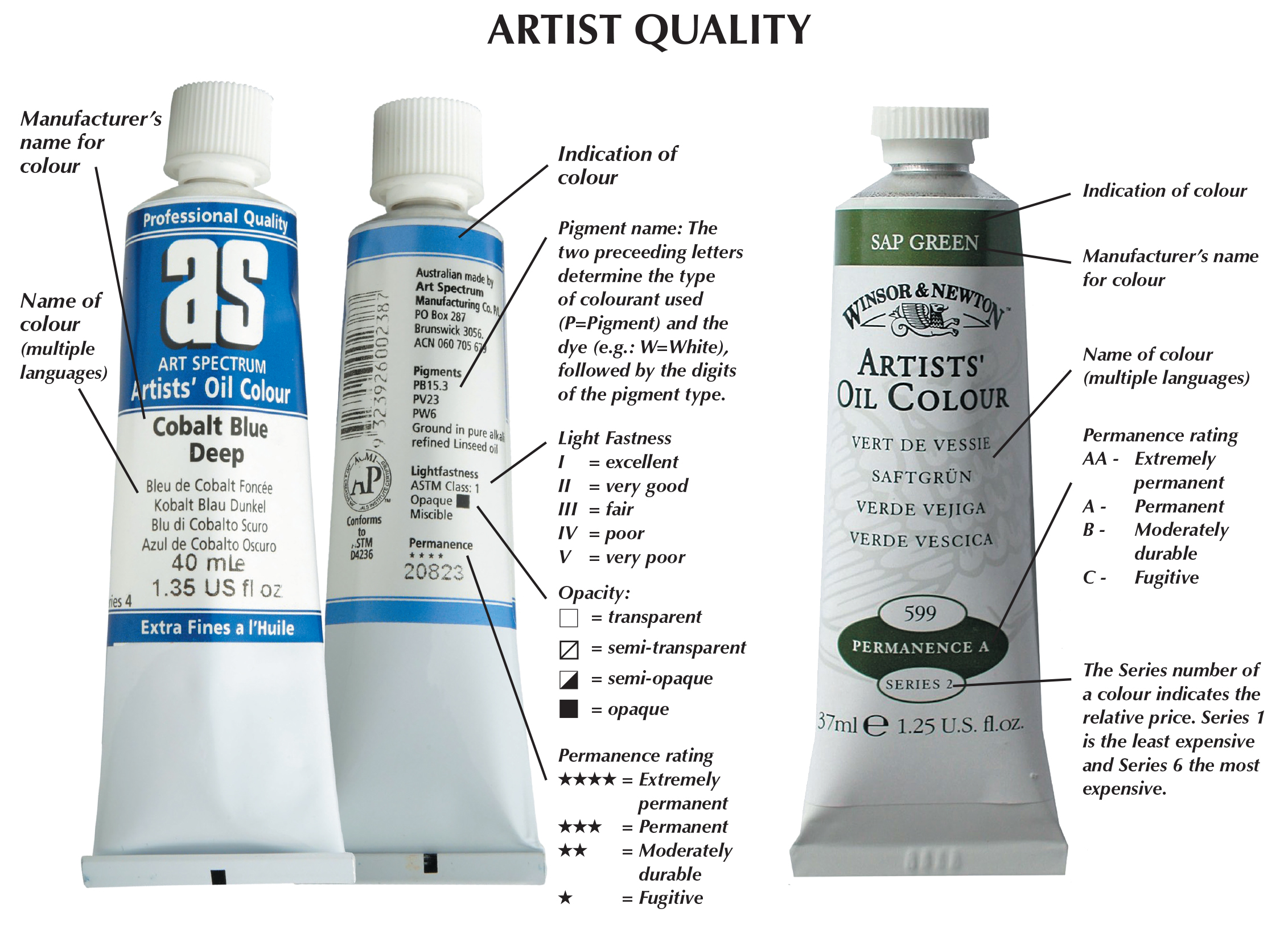
ARTIST QUALITY PAINTS
Every pigment has a unique Colour Index Name, consisting of two letters and some numbers. It’s not a complex code, the two letters stand for the colour family e.g. PR – Red, PY = Yellow, PB = Blue, PG = Green. This, plus the number identifies a specific pigment. For example, PR108 is Cadmium Seleno-Sulfide (common name Cadmium Red), PY3 is Arylide Yellow (common name Lemon Yellow).
When you are faced with two colours from different manufacturers that look similar but have different common names, check the pigments colour index number and you’ll see whether they are made from the same pigment (or mixture of pigments) or not.
Sometimes the paint tube label will also have a number after the colour index name, e.g. (PY (11770). This is simply another way of identifying the pigment – it’s Colour Index Number. An excellent blog to research this is Jackson’sartblog.
The light fastness rating printed on a paint tube label is an indication of the resistance a hue has to changing when exposed to light. Colours can lighten and fade, darken or turn grayer. The system or scale used for rating the light fastness of a paint and printed on the label depends on where it was manufactured.
Two widely used systems are the ‘American Standard Test Measure’ or ASTM and the British ‘Blue Wool System’. The ASTM gives a rating from I to V, with I being excellent, II very good, III fair or non-permanent in artists paints, IV and V pigments are rated poor and very poor and not used in artists quality paints.
The Blue Wool Standard gives a rating from one to eight. Ratings of one to three mean a colour is fugitive and can be expected to change within 20 years. Ratings of four to five mean the light fastness is fair, and shouldn’t change for between 20 and 100 years. A rating of six is very good and a rating of seven or eight is excellent.
Equivalents on the two scales:
ASTM I = Blue Wool Scale 7 and 8
ASTM II = Blue Wool Scale 6
ASTM III = Blue Wool Scale 4 and 5
ASTM IV = Blue Wool Scale 2 and 3
ASTM V = Blue Wool Scale 1
The Winsor & Newton tubes we show here have all the information printed on the front, but this is not always the case, as in the Art Spectrum tubes.
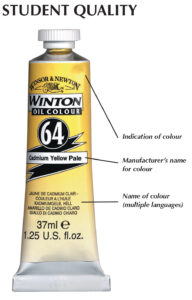 ARTIST vs STUDENT GRADE
There are two grades of colour available: artist quality and student quality. But what is the difference?
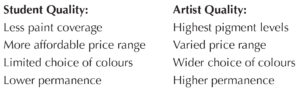
There is a big difference between student quality and artist quality paints. Student paints are made from less expensive pigments, so the range of colours is more limited and they also contain lots of ‘filler’. It is more difficult to mix colours well and the results are never as vibrant as artists quality paint. If you start out with students paint, you may feel less inhibited about wasting paint, but you should bear in mind that it’s better to buy the best quality paints you can afford.
Price
Paint pigments can be expensive and may vary in cost. Manufacturers group colours into various price bands depending on the amount of raw material used and what the raw material is. That is why artist quality paint is split into series e.g. Series A, Series B and other numbers such as Series 1 and Series 2. The higher the letter or number, the more expensive the paint, e.g. Cadmium Red is an expensive raw material so is classified as Series 9 (highest price) whereas Burnt Umber is made from a relatively inexpensive raw material and so classified as Series 1 (lowest price). It is important to note that Student quality paints are only available in Series 1 and Series 2.
Hue
The word ‘hue’ printed on a paint tube means imitation, i.e. not a pure Cadmium Red pigment but rather a combination of less expensive red pigments mixed to produce a very similar colour. This means student quality paint does not have the colour saturation that an artists grade will have.
Opacity
Pigments may vary in their transparency by nature. Different paints have different levels of opacity depending on the paint pigments chemical make-up.
Paint Sample
On most artist quality paints there will be a colour swatch of the actual paint on the exterior of the tube. This is really helpful when deciding which paints will suit your needs.