
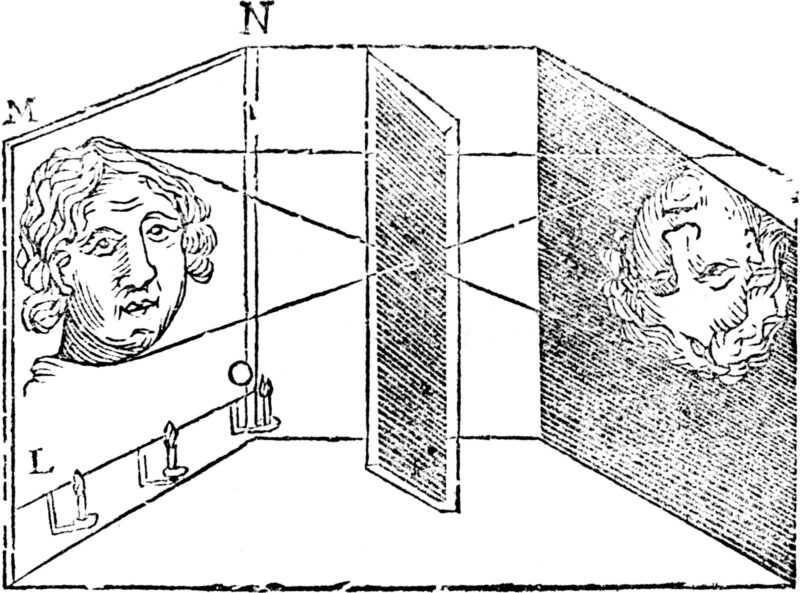
CAMERA OBSCURA
Artists using photographic references have long been accused of laziness, or even worse, excelling in technical capability while lacking in creativity. Others feel that it is a legitimate method of reference. We investigated.
While there are those who say nothing can substitute experiencing a subject in real life: being able to touch it, smell it, walk around it, inspect it, and all the rest of it, almost all artists will photo-reference at some point; not in their daily work but as part of their training to improve their artistic eye.
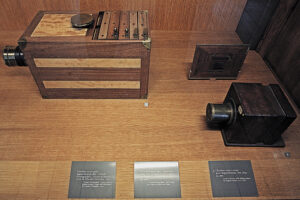
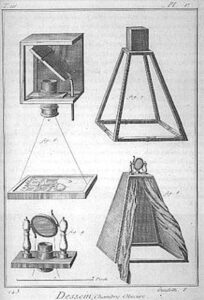
It goes without saying that photo-referencing, rather than working live is a practical alternative in situations where an artist seeks to realistically produce a work of art based on some subject that is not readily available be this a person, structure or scenic panorama.
But what would you say if you were told that 17th and 18th century Masters, such as Johannes Vermeer, Canaletto, Guardi and Paul Sandby among others, all well-known for their magnificent attention to detail used a camera to help them produce their work?
The camera they used was a device called camera obscura which is essence was nothing more than a darkened room in which light entered through a pinhole and threw an image on a wall or a sheet positioned opposite the hole. Try it for yourself. Go into a very dark room on a bright day. Make a small hole in a window cover and look at the opposite wall. What do you see? Magic! There in full colour and movement will be the world outside the window – upside down! This magic is explained by a simple law of the physical world. Light travels in a straight line and when some of the rays reflected from a bright subject pass through a small hole in thin material they do not scatter but cross and reform as an upside down image on a flat surface held parallel to the hole.
The earliest mention of this type of device was by the Chinese philosopher Mo-Ti in the 5th century BC. Aristotle (384-322 BC) also understood the optical principle of the camera obscura and in 1502 Leonardo Da Vinci gave two clear descriptions of the camera obscura in his notebooks.
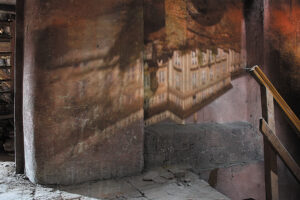
It was by simple deduction that an artist noticed a faint image on the opposing wall of a small building where a small hole let in light from outside of the building. He worked on a lens that could be placed the hole and saw the resulting image on the opposite wall was rather clear, colour and all, although upside down. He then proceeded to mix the oil paints that were in use to paint portraits at the time to match the colours and painted directly onto the image he was looking at.
Today’s cameras do the same thing minus the oil paint. Italian scholar, polymath and playwright Jovanni Battista Della Porta in his 1558 book Magiae Naturalis recommended the use of this device as an aid for drawing for artists.
As mentioned before, in the 17th and 18th century many artists were aided by the use of the camera obscura. By the beginning of the 19th century the camera obscura was ready with little or no modification to accept a sheet of light sensitive material to become the photographic camera.
So whatever your take on it, artists were behind the development of the modern camera. More to the point, photo-referencing has been going on for hundreds of years long before the first camera, practical for everyday use, was invented by George Eastman in 1888. Today the camera obscura is currently enjoying a revival of interest. Older camera obscuras are celebrated as cultural and historic treasures and new camera obscuras are being built around the world.
So the next time you hear someone denigrating the use of a camera or photographs to record an image you can point out that a camera and the resulting image have long been an integral part of an artist’s toolkit, as sure as his or her eyes and hands are.
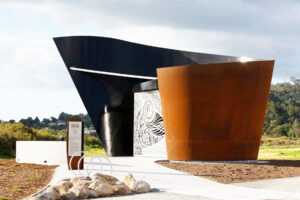
There is a Camera Obscura sculpture in Whangarei, just before the Te Matau a Pohe bridge, on the Hatea Loop walkway. Please visit next time you are in Whangarei: https://www.wdc.govt.nz/Community/Community-Facilities/Timatatanga-Hou-Camera-Obscura
Source: The Magic Mirror of Life, Jack and Beverly Wigus, www.brightbytes.com, Wikipedia, Yahoo.