

WHAT’S SO GREAT ABOUT PASTELS?
By Serena Dawson
 Serena Dawson who hails from Ngunguru, says she has been asked several times: “What’s so great about pastels?” In this article she sets out to describe – with examples kindly contributed by her – why she is so passionate about this medium, and why she thinks it has so much to offer. Although Soft Pastel is one of the most versatile and permanent of mediums it doesn’t enjoy the same respect as oils or watercolours, it is often discriminated against by galleries, and suffers under many misconceptions.
Versatility
Versatility epitomises all that is right with pastels. Pastels can be used like oils, they can be made to look like watercolour, they can be used lightly and sparingly or laid in heavily. You can under paint with other mediums, or wet your first layer of pastel down with water or alcohol to make a pastel under painting.
Further to this pastels are so forgiving, especially with a high ‘tooth’ paper such as Colourfix. You can rub off, scrub off, wipe down with water or thinners or lift off with a kneadable eraser or even sticky-tape. You can blend with a finger or rag or blending tool. You can add layer after layer, and if you run out of tooth just spray with fixative and keep going! You can use pastel on top of dye or watercolour or acrylic or oils or even fabric. The diversity of style and technique employed by pastel artists world-wide is stunning. The only limit is your imagination.
Simplicity
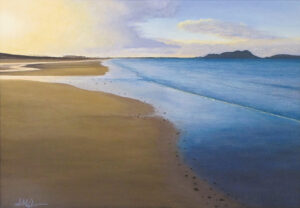
The stroke of the stick of pigment against an abrasive ground, leaving the pigment in the ‘tooth’ of the paper, is the long and short of pastel painting. There are no colour-mixing rules to learn, no smelly chemicals to handle, no forces at work except the stick of colour wielded by your own hand.
You don’t have to know how to handle a brush or learn to dance with that mysterious element water. Simply make your mark, and then another mark, and another.
I believe Pastel to be the easiest medium to learn. Of course this is my opinion, but most artists agree that Pastel is among the easiest mediums to pick up for someone starting in the arts.
Beauty
Pastel is the closest you can get to painting with pure colour. While erroneously called Pastel-Chalks by some, chalks are made by soaking white chalk (calcium carbonate) with dyes, but artists quality pastels are made from the purest pigments, ground many times to make them very fine and easy to use. While mediums such as watercolour, acrylics and even oils flatten as they dry due to the carrying agents, binders and additives mixed with the pigments, Soft Pastel uses a minimum of binder, usually gum tragacanth. Once the stick of pastel is formed and allowed to dry, it needs no other additive or medium.
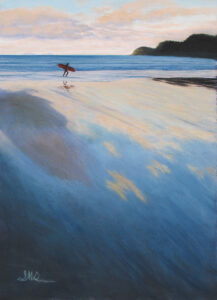
If you examine a pastel painting under a microscope the pastel is seen to be tiny granules of pigment, each grain reflecting the light like a tiny prism. Do you remember the advertisement for ‘Natural Glow’ make-up? “ and the catch line ‘Thousands of luminous spheres,’ I always remember this phrase as I watch the light moving across one of my paintings. A Pastel responds to the light in a very unique way, almost glowing at times through the changing light of the day.
Brilliance
Although commonly perceived as a delicate medium, When Pastel paintings are properly framed and hung, not in full sunlight or a damp environment, they outlast all other mediums. There are pastels painted in the 16th century that are still as beautiful as the day they were painted.
Because there is a minimum of binder added, there is nothing to make the pigment yellow or discolour. The pastels will not crack as oils can, and are very resistant to fading.
This is assuming you have chosen to use high quality materials made of the highest quality pigments.
There are cheaper pastel brands which are fine for learning but are not so easy to work with and are prone to fading.
Convenience
If you don’t have large blocks of time to paint, nothing compares to the convenience of Pastel. There are no colours to mix, no brushes to clean when you finish. You can pick up a pastel, make a few strokes, and leave the painting for an hour or a day or a year. For those with a young family or many demands on their time it gives you the flexibility to be creative without worrying about ruined brushes or a painting gone dry too soon. You don’t have to pack water or mediums if you travel or like to paint plein air. It seems the perfect medium to take on adventures- always ready to catch that fleeting moment of light.
The Menace of Dust
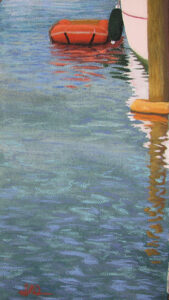
Despite all the wonderful points to painting with Pastels there are downsides to the medium, here I discuss the main ones and suggest some ways to manage them.
Pastel is a dry medium, and no matter how careful you are there will always be some amount of dust under your easel and around your working area. Some people find the dust irritating, especially if they have asthma or allergies.
The first step is prevention. Pastel dust should never be blown from a painting or surface but a painting should be tapped to get rid of loose dust, preferably outside or in a well ventilated area.
Pastel paintings are always painted upright as this allows the dust to fall freely from the painting without dirtying the work as you go. A wet cloth or wet-wipe is good for surfaces, and mopping, rather than vacuuming, is preferable for your studio floor. If you don’t have hard flooring in your studio area I highly recommend a plastic mat of some kind under your easel; Pastel dust is super fine and you will never get all the dust out of a mat or carpet!
A very important step is to have some kind of collection device under the picture itself, my favourite and the simplest solution is to have a piece of tin foil along the length of the bottom of your picture, sticking out a couple inches; when you finish a painting carefully remove your tinfoil ‘gutter’ and put it folded into the rubbish.
A clever chap has invented a system that joins directly onto your easel and is called ‘Artists’ Air’, it is the ultimate solution, but comes at a cost. It also helps with the odours related to oil painting.
Framing
Pastels need to be framed under glass. This is another cost for the artist, and of course for the buyer of a pastel painting. Some believe framed works are harder to sell than canvasses, and they are easier to damage when being transported. I have been told by many galleries, “Customers don’t like works behind glass. You should try oils instead.” Yet I have never heard this in relation to watercolours, which I find strange. I believe that a beautiful painting sells itself to the right buyer, regardless of medium or whether it is framed behind glass.
Pastels should have a space between them and the glass, usually a ‘mattboard’ is used for this, but you can also use special plastic strips which fit between the artwork and frame if you want a more oil-painting look.
You can buy ready-made frames which have a mattboard fairly cheaply from places like the Warehouse, these are designed for people to put their own photos in and are simple to handle. A custom-made frame is more expensive, but you can be sure you are getting conservation-quality materials and expert handling of your precious painting.
A good compromise is to buy a ready-made frame and then get a framer to cut a mattboard to fit, this usually is quite reasonable and you get to choose the colour of mattboard to match your painting.
Cost
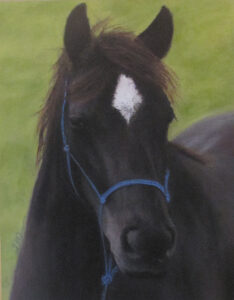
The cost of starting in pastels is likely to be higher than other mediums. With oils, watercolours and acrylics you can literally start with 4 or 5 tubes of colour and mix the shade you need. Because Pastels are not mixed before painting you need to have a good variety of colours and tints available. You can mix the colours to a small degree on the painting itself, but it is easy to make mud.
The ideal is to have all the right colours and shades, but of course this comes at a cost. You can buy start-up sets, sometimes at a special price, and slowly add to your collection as you decide what colours you need. If you pick a selection yourself to start, try to have a light, medium and dark shade of each colour you pick. It is best not to go for overly bright shades to start, they might look pretty in the store, but you are more likely to need subtler, greyed tones, especially if you paint landscapes.
A good idea if you have the Internet is to buy from America. There is a lot more competition there and you can get amazing bargains, check out DickBlick.com for a start. If you are concerned about the shipping part, go to your local Postshop and ask them about getting an address in America, it is a special thing Postshop have set up so you can take advantage of free shipping within America, and makes getting things shipped home to NZ easier.
Making mud
The most common struggle for pastel beginners is the painting turning into a grey, muddied mess, instead of the bright and bold colours they started with. The paper ground will only hold a certain amount of pastel; if it is a high tooth paper, such as Colourfix, you have a lot more lee-way for how many layers you can get on before it turns to mud. A lighter paper, such as Canson, will hold less and needs to be treated more gently. I strongly suggest starting with Colourfix, which feels like fine sandpaper. It can handle a lot of abuse, and if you make a mistake there are more ways of fixing it. The easiest, if it is a large area, is to scrub off the offending area with a bristle bush. If you want to start over you can even scrub it lightly under running water, as the Colourfix papers are made with watercolour paper. Dry flat and start again.
If you have some hard pastels, or pastel pencils, which all come under the umbrella of ‘soft’ pastels, as opposed to oil pastels, these are usually used to draw in your composition or for small details, the softer pastels for later layers.
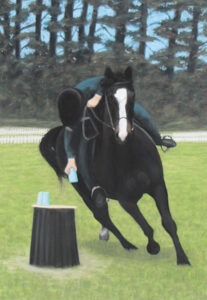
Try to have a clear idea of what you are planning before you start, as in oils it is the going back and changing things, correcting things that don’t need to be, that usually ends in mud. Usually pastels are painted from dark to light, in a similar fashion to oils.
Half-way through you should stop and have a good look- do you really need to change that detail? Look at the painting in a mirror, to show up any oversights. Slow down the amount of painting you do in comparison with how much you study; as you near the end do twice as much looking as painting. Use a light hand. Feel the painting through the pastel, the last strokes should usually be the lightest.
Pastel is gaining more notice, prizes and popularity but hasn’t yet reached the standing in NZ that it enjoys in Australia. I believe that in time it will gain all the recognition it deserves.
Pastel Artists of NZ, (PANZ), is a wonderful group doing great things for the medium. Check out their website!
Painting with Pastel is unlike any other experience, it combines the most brilliant colours of painting with the immediacy and responsiveness of drawing. I have experienced more joys by far than frustrations in my journey with pastel, and I believe the positives of the medium far outweigh the negatives.