
TELL ME ABOUT CANVAS
What is it that professional artists look for in the painting surface when selecting a canvas? As in most things it comes down to personal preference. Durability and longevity are generally top priorities, but when it comes to the actual painting surface things get a bit murky. Words like slippery, thirsty, aggressive, tooth, absorbent. What do they mean? Basically artists want a surface that suits their individual painting style.
COTTON DUCK
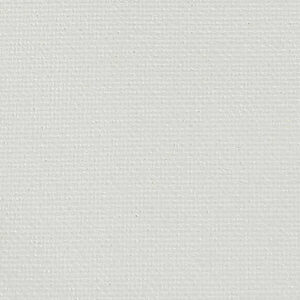
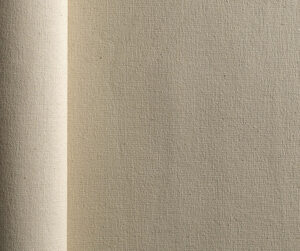
Cotton Duck is the most common canvas choice for artists to paint on. Made from the fibres of the fruit of the cotton plant, the material is 100% natural, that once stretched, forms a ground support which has good adhesion to sizing and priming layers.
Its relative cost effectiveness, medium-toothed texture and natural feel give the cloth appeal for a variety of artistic techniques. The warp and woof fibres need to be tightly laced at right angles, however, to hinder primer undercoats from seeping through to the back-end of the cloth. Although differently weighted Cotton Duck is used in a wide variety of different applications, only the more expensive and heavier cloth is suitable for professional painting purposes; 10oz cloth is sufficiently heavy and with a thickness of approximately 0.68mm, gives the material durability and strength for palette knife work.
In its natural state, the cloth has an off-cream colour in appearance. Depending on your supplier it may be available in 3metre wide rolls. A stretched canvas therefore can be as large as 2.7 meters by 5 meters+. The cloth is washed and scoured, removing any latent residue as a consequence of the milling process. As a default, Cotton Duck canvas is double-primed with a pure acrylic flexible polymer that has low VOC’s (volatile organic compounds) and is lead free. Extenders within the primer are calcium carbonate and titanium dioxide (whitener). The primer is essential to obtain a support that is flexible, protecting the underlying fabric from canvas deterioration and allowing the correct absorption of oil or acrylic paints. Extra coatings can be given so that the final finish tends toward a smoother feel and more lustrous appearance.
Gesso and binder medium can also be used in combination with an acrylic primer. Gesso tends to add more texture or tooth to the final finish while limiting the absorption of oil and acrylic paints. Being a natural fibre, the cloth is hydroscopic in nature and can relax depending on environmental conditions; when dampened, the individual threads become thicker and shorter causing the intervening openings to close and hence an overall tightening on the cloth. During dry conditions, the reverse process causes the cloth to slacken or ‘relax’. An expansion stretcher frame is therefore needed with keyed wedges in the corner and cross-bar struts. These can be gently tapped in, effectively bringing the cloth back to a taut state.
In summary, Cotton Duck’s versatility has found favor for many different styles of artistic impression. Its toothed surface finish grabs brush paint easily, giving long-lasting adhesion to priming and subsequent oil or acrylic paints.
POLYESTER
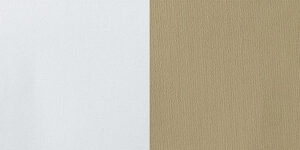
A synthetic fibre, polyester cloth has properties unique to other cloth types, making it increasingly popular for artistic purposes. The fibres are thin and tightly interlaced so that a very smooth final finish is achieved. This makes the surface ideal for high detail or portrait work, with very little paint bleed occurring on brush lines. The cloth is significantly stronger than Cotton Duck or Linen, allowing tighter stretching with the resulting surface having little give to applied brush strokes. Polyester cloth’s moisture absorption is extremely low and therefore resilient to shrinking or swelling; a stretched canvas is stable without the need of a humidity-controlled environment. It can also therefore be unrolled on the floor with little creep or shrinkage occurring when worked on.
The cloth appears as a clean, bleached white colour. This brightness gives the picture from the outset an added effect of clearness and luminosity. Light resistance is also extremely good, having the best resistance to ultraviolet radiation in daylight. The primer is essential to obtain a support that is flexible, protecting the underlying fabric from canvas deterioration and allowing the correct absorption of oil or acrylic paints. Polyester cloth is double-primed with a pure acrylic flexible polymer. Extenders within the primer are calcium carbonate and titanium dioxide (whitener). This acrylic gesso primer contains a dispersion medium that facilitates good adhesion to the cloth fabric, and in combination with thickeners and stabilizers, ensures a primer with sufficient tooth and absorbency characteristics.
Polyester cloth shows good resistance to chemicals that can occur in oil or acrylic paints; this in combination with using an acrylic polymer primer that is non-hydroscopic, produces a ground that does not require size. In summary, Polyester cloth’s strength, very fine texture and durability make it ideal for high detail or palette knife work.
LINEN
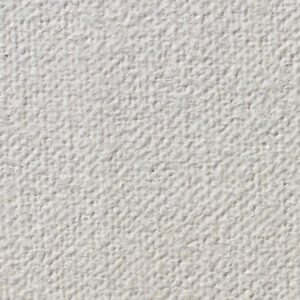
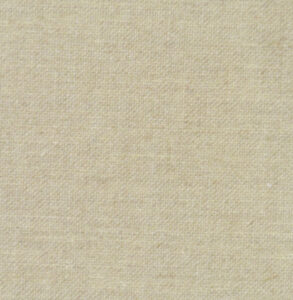
Linen, grown from the flax produced in Belgium and the Netherlands, is still considered to be the superior choice for professional artists who want to work on a specific textured cloth. Linen canvas is distinguished by its unique natural colour and irregular character of weave, which is the result of the round shape of the linen fibres – this characteristic persists through the layers of paint, imparting a sense of depth to the work.
Individual linen fibres are considerably longer and springier than cotton; the material is therefore somewhat more durable and has a livelier feel when stretched. Machine coated a number of times with either oil, or universal primer or glue sizing, very specific methodologies are employed to obtain a uniform surface. For an oil canvas, zinc white is used in the primer, bound with linseed oil. After drying, a coating of titanium white is given. With acrylic or universal linen, two coats of titanium white are applied with an acrylic binder.
There is considerable variety of weave texture and weight available. Surface textures range from extremely fine (13DPS) to very rough jute (H4), with different textures and priming types falling between these two extremes. The cloth is also available unprimed or, what is becoming increasingly popular, glue sized, allowing the unique canvas colour to come through the artwork.
As with Cotton Duck, being a natural fibre, the linen fibres can respond to changes in humidity, swelling in humid weather and shrinking in dry weather. The stretcher frame therefore needs be keyed with suitable wedges in the expansion corners as well as cross-bar struts.
Belgian Linens, given their reputation and popularity among professional artists, are higher-valued than Cotton Duck or Polyester cloth. With this comes the pleasure of working with a material that can be specifically suited to the artist’s style and preference and carries the nostalgia of using a cloth trusted by the Old Masters.
Compared to modern techniques, the Dutch and Flemish Masters had their own unique way of preparing a canvas thereby ensuring that no fabric was visible through their paintings. This process required a months-long process of layering the raw canvas with paint, polishing the surface and then repeating. This technique produced a glossy, almost enamel surface, which was crucial in achieving photographic realism.
References:
[1] The Artist’s Handbook of Materials and Techniques. Fifth edition. Ralph Meyer
[2] The Artist’s Pocket Guidebook. Jim Cobb and Kirk Miller
[3] The Painters Handbook. Mark David Gottsegen.
[4] The Materials of the Artist and their use in Painting. Max Doerner.
IS MY CANVAS SQUARE?
There are two ways of checking that a canvas is square. Firstly by using a carpenter’s square. This is an L shaped tool that is used to check a 90 degree angle. You simply place it over the corner of the canvas. The two sides of the carpenter’s square should lie parallel to the sides of the canvas. If you see any gaps, the canvas is not square.
The second method is to measure the distance from one corner of the canvas to the other – across the diagonal. So measure from the top left corner to the bottom right, and then from the top right to the bottom left. It the two measurements are the same, the canvas is square.
WHAT’S IN A CANVAS?
We decided to put the question to a few professional artists to find out what their personal preferences are.
A reliable surface that is durable and functional. It must be able to multi task. Not too absorbent. Must perform with thick paint, thin paint and washes. Able and willing to take punishment.
Pascale Chandler – Artist and teacher.
Must be in square on an appropriate stretcher frame using the correct wood and materials and stretched to the correct tautness. Requires the correct primer for the appropriate canvas. Important that the applied paint/medium takes easily to the primed surface and adheres correctly to it. I believe a stretched canvas should be oil based primed as per the old and proven method. Acrylic primer should be avoided for a stretched canvas, but is perfectly OK for a canvas laid on board. Too thin a canvas is not ideal and should probably not be used. Lets also bear in mind that different canvas finishes are apt for different art techniques applied by the artist. If all of the above is applied, one will have a good canvas for painting on.
Rob Domajin – Artist
I am looking for a canvas that moves the paint around. When I apply the paint with a brush (generally a large brush), I want to be able to ‘push’ and ‘pull’ it to directions where a brush can’t go – either using a spatula, palette knife, home-made tool and even fingers. I want my canvas to be smooth and tight on the support. I don’t mind a bit of weave (though generally choose a fine weave) as long as the surface is smooth enough for the paint to adhere to the surface and move. I try and use my oils like watercolors so movement and happy accidents are necessary (which can never happen on a ‘thirsty’ canvas). It goes without saying, that the canvas must be made with quality products to ensure longevity of the painting.
Nicole Pletts – Artist
With the modern trend of ‘floating’ a canvas in a frame it is essential that the canvas on its stretcher is square. These frames are designed to show the edges of the canvas and if it is not exactly square it will be very obvious. There is not rebate or over-hang as there are on traditional frames to hide an un-square canvas. I also prefer a medium canvas but very well primed and lightly sanded, it seems to make the paint go further.
Nola Muller – Artist