Choosing your watercolour paper is more important than you think, and can definitely affect the outcome of your painting. It is important to acquire the best watercolour paper your budget will allow. This being said, what is the best for you? When you work with fine detail, a rough paper can be very frustrating, and if you are looking for interesting water effects, a smooth paper will do your head in. We discover the in’s and out’s of watercolour paper, in an attempt to assist you in making the best choice.
How is paper made?
Initially paper is started with pulp. There are many sources of plant used to make pulp. Heaps of paper we see every day is made from the pulp of trees. But regardless of the source of the plant, the plant fibres must still be rinsed, screened (and sometimes bleached) and then mixed with water and chemicals.
The pulp is thoroughly pounded to macerate and separate the individual cellulose fibres. This pounding bruises, cuts, folds and tangles the fibres in ways that increase the paper’s density and strength. After the pulp has been thoroughly macerated, it is diluted with roughly nine times its bulk in water and energetically stirred in a vat, which may be as small as a bathtub or as large as a swimming pool.
Some manufacturing methods will align the paper fibres in the same direction, and these biases form the grain of the paper. In machine made and to a lesser degree in some mould made papers, the grain runs the length of the web (parallel to the deckle and perpendicular to the path of moulds or rollers). There is no grain in handmade or rough shake papers (the alignment of the fibres is random). Papers are easier to tear or fold in the direction parallel to rather than across the grain. Cellulose fibres expand in width when wet, which causes machine made papers to return to the curl of the mould cylinder that made them, or to produce cockles that lie in parallel ribs; in most mould made and all handmade papers, the pattern of cockling is random. The most common commercial art paper is manufactured by machine, hence the term “machine made”. However, “mould made” paper is also manufactured by machine using a cylinder mould. Typically, “handmade” paper is also made with a mould although it’s not cylindrical.
Regardless of manufacturing method, the sheets of paper must be dried. The more common and economical industrial method is restraint drying the sheet: removing water from the cellulose fibres while the sheet is held flat. Deckle edges are sometimes simulated in mould made papers by cutting or trimming a larger sheet with a jet of pressurized water, which produces a frayed, irregular edge. Mould made papers often have two genuine deckles on the long sides of the web, and smaller imitation deckle edges on the short sides where the sheet has been cut lengthwise from the web.
Paper finishes
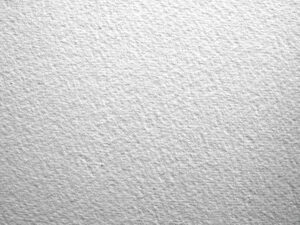
Watercolour paper grain
The finish of the paper is affected both by the mould screen and the texture of the felts or rollers used (or not used) in drying the paper. The felt side of the sheet faced away from the mould and only received texture from the felts used in rollers or drying. The wire side of the sheet settled onto the wire screen of the mould, and received texture both from the mould and any felts used in rollers or drying.
Cold pressed paper is made by hanging the sheets to loft dry in spurs (clusters) or by pressing the posts under a mechanical press (for handmade papers), or by calendaring the sheet with light pressure through felt covered metal rollers (mould made papers). This cold pressing gives the sheet a subdued texture that is relatively easy to use, can tolerate a certain amount of corrections or lifting, and is congenial to almost any style of painting. The sheets are more dimensionally stable when wet, and (depending on manufacturer) are usually less absorbent than rough sheets.
Hot pressed sheets (both mould made and handmade) are calendared at high pressure between heated glazing rollers or a highly polished cold metal roller, which creates a smooth, almost polished finish. These sheets show a high degree of brush detail and tend to show pigment colour more brightly: the surface sizing and fibre density resist paint absorption so more of the paint stays on the surface. Hot pressed papers are often the most congenial to lifting dried paint by moistening and blotting, though the smooth surface reveals any abrasions more clearly. These papers are especially suited to painting styles that want to accent the watery irregularities of the paint, or styles (such as botanical illustration) where precise pen and ink outlines or drawings, or fine brush textures, are essential to the desired effect.
In addition to these mechanical variations in surface texture, watercolour paper is also chemically treated to alter its absorbency. Internal sizing is added to the paper pulp before the sheet is formed and chemically bonds to the paper fibres. External sizing is applied to the surface of the finished sheet of paper after it has dried, sometimes by dipping the entire sheet into a tub of sizing solution (known as tub sizing).
Animal gelatine sizing is the preferred external sizing: it is naturally transparent, slightly water soluble, gives a hard surface that can be scraped or sponged away without damaging the paper itself, and imparts a warm tint to the sheet. However, gelatine is not the most common internal sizing for watercolour papers — for this there are modern substitutes such as carboxymethylcellulose (a common food thickener derived from cellulose, trade name Aquaplast) or alkyl-ketene dimers (AKDs or “dimers”, trade name Aquapel).
The watermark is a visible mark in the sheet, usually the name or an identifying symbol of the paper manufacturer, most easily seen by holding the sheet up to the light.
Paper Format:
In the manufacture of machine made papers the metric system is now used, based on the A0 sheet (84 x 119cm, or 33” x 47”, a ratio of 1 to 1.41) and successive half sheets from it (designated A1, A2, A3, etc.), or the B0 sheet (100 x 141cm, or 40” x 56”, also a ratio of 1 to 1.41) and successive half sheets (designated B1, B2, etc.).
Weight of Paper:
The traditional specification (from the British Imperial system) has been the weight in pounds of a ream (500 sheets) of the paper. The imperial or full sheet (22” x 30”) was taken as the standard size to define the weight of smaller sheets, as smaller sheets were typically torn from it. (The imperial equivalent weight is still used to describe the paper used in watercolour blocks, for example.)
*The ream weight is different for larger or smaller dimension papers, because the volume of paper in a ream changes.
We have been told many, many times to “Paint Like a Millionaire!” Essentially, it means to buy the very best supplies that your budget will allow.
How Paper is sold:
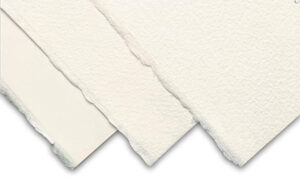
Arches paper
Handmade papers are usually sold by the individual sheet. Machine made or mould made papers can be purchased individually by the sheet or in packs, rolls or blocks. Watercolour rolls are typically about 10 yards long and, depending on manufacturer, come in widths from about 40” up to about 60”. The wire side usually faces toward the spool, which means the edges should curl downwards if you want to paint on the felt side. The artist can get about twelve 29” x 40” sheets, or six 40” x 60” sheets from one 43” wide roll. They are also the obvious choice for paintings in unusual sizes, or for creating very large works several feet long.
Individual Sheets are commonly available from all retailers in the widest range of sizes and weights and in any quantity. These are usually wrapped for shipping in brown paper inside a carton. Slit one side of the wrapping to pull out individual sheets, but leave the rest in the wrapping to protect the papers against moisture and dirt.
Watercolour blocks are for paper in sizes smaller than the full sheet — from 18” x 24” down to postcard size. These are made of a stack 20 sheets (usually only in 185 GSM or 300 GSM weights) that are bound together to a very heavy paper board backing by a thick adhesive applied around all four sides. A heavy sheet of cover paper, printed with the manufacturer’s usual marketing gaudiness, is folded over the front to protect the exposed top sheet.
Paintings are done with the paper fastened to the block, which eliminates stretching and fastening a single sheet on a board support. (Block papers are not stretched, but fairly well resist cockling or warping when wet, at least in the 300 GSM weight.) When the painting is finished, the artist inserts a blade or palette knife under the top sheet at an edge area where the sheets are left ungummed, then runs the blade around all four sides to cut the sheet away, exposing a fresh sheet underneath.
Blocks transport well and are really ideal for field painting. The main drawback is that the cold pressed or rough sheets lack the character of individual sheets: the textures are smoother, less irregular, more flattened, in order to make the blocking uniform. Blocked sheets also do not have deckle edges, though tearing after the painting is finished can simulate these. You pay approximately a 30% premium for this convenient and durable packaging.
What is sizing?
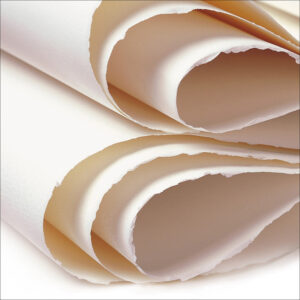
Fabriano paper
Papers are traditionally sized with gelatine. The amount of sizing determines the amount of color the paper takes into its structure. Heavier sizing allows more color to stay on the surface and allows easier reworking of the paint. Internally sized paper has the sizing added in the vat before the paper is made. Tub sized papers are soaked in a sizing bath after the paper is made Tub sized paper is the preferred choice of watercolorists. A paper that is too heavily sized can resist your brush strokes. To remedy this sponge your paper with clear water once or twice. This will eliminate some of the surface sizing and make the surface more receptive. Papers that are stretched lose any excess sizing in the streching process.
Paper Storage
Store your paper or paintings flat, dry, cool, and out of direct sunlight, and you should be fine. Leave stacks of paper in the original wrapping, and slide sheets out one at a time, from the top. Lift and hold a sheet at the opposite corners, with both hands, and carry it vertically so the paper does not shear in the air and bend or tear.
Paper exposed to direct sunlight is at high risk to yellowing and could become brittle. The fact that sunlight can reach it at all means that humidity and temperature changes will affect it as well. Since paper is also affected by humidity and temperature, keeping the paper wrapped and stored in the dark, or in flat files will serve to protect your investment.
The best protection is to
• frame finished works immediately, sealing the back of the frame completely and using ultraviolet shielding Plexiglas as a cover
• keep paintings hung away from direct sunlight or indirect sunlight from large windows; fluorescent lights are less of a hazard, but beware of prolonged exposure to bright lights or lamps of any kind
• hang the painting in areas with relatively small fluctuations in a moderate average temperature and humidity
• never store a watercolour painting in areas such as attics or basements where it may be exposed for prolonged periods to cold, damp, or insects.
Damage to paper or paintings from environmental hazards are usually irreversible and often irreparable.