
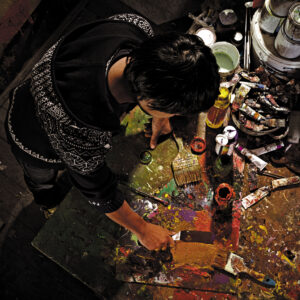
It’s two-o-clock in the morning, you are standing in front of your easel, you can’t remember when you last had a decent nights sleep or even a proper meal for that matter. You are too tired to paint but realise if you stop now you won’t sleep anyway. Not that you are getting very much work done. The canvas is a mess and you are going to have start from scratch. You have an exhibition coming up, you promised some clients you would have their work finished but haven’t even started on them yet and you have no idea what you are going to paint. Maybe being an being artist wasn’t such a good idea after all. It used to be fun. You had so many ideas. You were prolific!
Sound familiar? It’s burnout! According to Newfoundland artist Graham Mathews, artists tend to push themselves too hard, and periods of artist block and creative burnout are common. We want our work to be recognised so much that we spend all our free time creating art without leaving any time for ourselves and it is ourselves who actually create the art in the first place.
Productivity guru Charlie Gilkey says we get on a creative streak and push ourselves too far when we’re in the ‘post-Eureka’ stage of the creative process. While being in the throes of a creative maelstrom is enlivening, it requires a lot of physical, emotional, and mental energy. Pushing past your natural limits stalls the creative process, resulting in burnout.
A second scenario occurs when we get into the implementation phase and lose that initial curiosity and adventure that we had when we first stumbled upon the idea. It no longer inspires us. This is the difference between wanting to explore and develop the idea versus just getting through it. The former is something that we want to do, whereas the latter is something we feel we have or need to do.
Mathews says each person has to work out the root cause of their own burnout so they can deal with it. Are you over-worked? Do you push yourself too hard? Do you ever take time off to access your situation, your work ethic, where your works fit into your own life and the lives of those around you?
Mathews and Gilkey say sometimes all we need for rejuvenation is a little time away. If you are working too hard, creating art becomes more of a chore when it should be enjoyable. Do something different. Take a road trip, go camping, take a hike, watch a movie, go to a concert, have a night out.
Eight tips to help you get over creative burn out . . .
- Avoid stagnation in your art. Try new things, experiment with new mediums, use different techniques.
- Some artists like to plan out their days in increments, with amounts of time allotted for specific tasks. Others work better with less structure. Most of the time, this disposition is a part of our nature. Working against it to become more structured, when this only causes stress, can lead to creative burnout.
- Keeping a healthy body and mind will go a long way in preventing and dealing with burnout.
- Stop being too self-critical. When we hit a creative roadblock we become hard on ourselves. We are not living up to our own expectations, self-disappointment sets in. Burnout is a natural reaction when we are working too hard or do not have balance in our lives. Everyone has limitations.
- Think back to your first year as an artist. These were exciting times, full of confidence, everything came naturally, you enjoyed mixing colours and creating depth and movement on a canvas. Think back to those days, and recapture that spark.
- Persevere. There is light at the end of the tunnel. Creative burnouts often last anywhere from a day to weeks depending on how hard you have pushed yourself. You will get through this.
- Further to this, leave yourself breadcrumbs so you can get back to the emotional space you started the project from. Was it a friend that got you fired up about the idea? If so, remember who that person was so you can ask about the topic again. Was it a book you read? If so, bookmark the passage that gets you back to that mind space. If you find yourself removed from the endeavour, shelve it. If you return to it later and it’s still dead to you, let it go.
- Lastly, remember that creative burnout isn’t an indication of your inability to make a go of your creative thing. It’s easy to hit a wall and mistakenly assume that you aren’t cut out for what you’re doing. Before you assume that you need to quit, take the time to fully reset and re-evaluate.