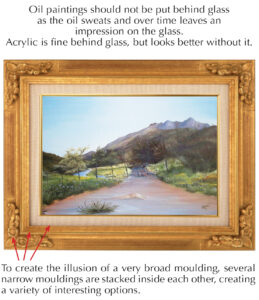
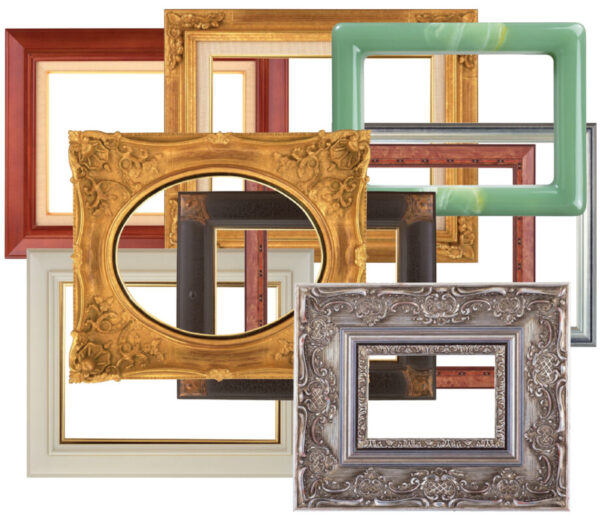
Today there are more types and varieties of mouldings for frames than ever before. Traditionally frames were made from wood and the patterns and textures applied with a coat of plaster which was then coloured with paint or covered in gold leaf – a technique known as gilding.
Advances in manufacturing techniques and the use of synthetic materials has resulted in a range of affordable mouldings that look very much like the real thing.
The increase in the price of wood and the cost of profiling and finishing has led manufacturers to use alternate materials. Today they have largely switched to plastic and resin products which are extruded in any number of shapes and finished in a variety of finishes which are achieved by applying different foils to the moulding. Wooden mouldings are still available but come at a cost when compared to the synthetic products.
2) Choosing a frame
Standing in a framer’s shop looking at hundreds of corner samples can be a daunting and confusing task. The best advice is to choose a frame that is suited to the work you are framing. Trends and fashions come and go and styles of framing too. In the eighties it was high-gloss primary colours, in the nineties the fashion was lime-washed wood and in the first decade of the new millennium we could not get enough of flat, square mahogany frames. Of course these are broad generalisations, but you get the idea.
3) Choose a mount to match the painting – not the room
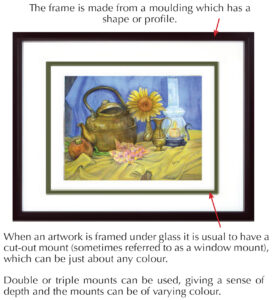
When framing a watercolour, pastel work or artist’s print one generally has a cut-out mount surrounding the work inside the frame. Mount board comes in as many colours as you are able to imagine – making the choice of colour quite difficult. Here the advice is much the same as above; select a colour that matches or compliments the work, don’t choose the mount board to match the colour scheme of the room in which the work will hang. Rather go for a neutral coloured mount that will still look good if you decide to move the frame to another room or you change the colour of the walls.If you are selling framed work, neutral colours are a safe bet as they will fit with most buyers’ colour schemes.
4) Use Acid free materials
When framing original works on paper, such as watercolours, pastels and prints, it is important to use only acid free framing materials. Most of the mount boards are acid free but the backing boards are not. Ask your framer to back the work with an acid free board such as ‘fome-core’. This might cost a little extra but will prevent the paper of your valuable work from yellowing. Also check that the framer is using acid free tape to fix the work to the mount. The reason for avoiding materials that are not ph neutral is because they do not last. Think of newspapers and how quickly they yellow with age.
5) What about dry-mounting?
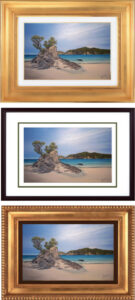
Matapouri Beach, Whangarei – Painting by Megan Lavin-McIsaac. In the three examples above we can clearly see the difference a frame makes to the same painting. There are few rules governing the type of frame that should be used. It all comes down to personal taste and the effect one wants to achieve. The bottom frame creates a classic feel while the middle example has a more contemporary feel to it. Note how the white inner frame against the painting in the top example has an effect on the tones of the painting, and compare it to the dark inner frame in the bottom example.
Works on paper tend to buckle a little, this is the nature of paper. Many people don’t like to see a buckled work in a frame and the framer’s solution to this ‘problem’ is mounting or sticking the work onto a flat rigid board. This is done either with heat activated adhesive tissue in a heat press, or with a liquid adhesive in a vacuum press. Either technique will successfully flatten the work. Both are irreversible processes and not advisable for original artworks. Okay for calendar prints but not for anything more valuable.
6) The choice of glass
Glass is used in framing to protect the work and keep it clean. Your framer will offer you clear or non-reflective glass. Most galleries prefer clear glass because, as its name suggests, it is clear and gives the best view of the work. Non-reflective glass has a textured surface to break up the reflections associated with clear glass. The problem is that it also effects what we see through the glass as it tends to dull the artwork.
7) Don’t go for the cheapest moulding
Framing is expensive and it is tempting to choose a narrower moulding thinking that it will drastically reduce the overall cost. So consider this. If you are framing a watercolour, the cost of framing it is made up of the following: the cost of the glass, the window mount and the backing board, and then the frame that goes around it all. The cost of the glass, window mount and backing boards are calculated according to size, so their cost will remain the same regardless of what frame you choose. The actual frame only accounts for a portion of the overall cost so by trying to save money by choosing a cheaper moulding won’t actually save you all that much.
8) DIY can save you money
Framing is a labour intensive exercise so when you pay to have something framed, you are paying for that labour. If you are at all handy you can buy frames from your framer and fit the artwork into the frame yourself.
9) Choosing a frame to compliment the picture
With so many different types, colours and shapes of mouldings these days it is important to choose a frame that will strengthen the work, rather than take away from it. The size of the painting also determines the width of the moulding. Small paintings can be framed in a very broad moulding, but large paintings seldom look good in a skinny moulding. The extent of the decorative finish on a frame is a personal thing. When it comes to traditional landscapes choosing a frame that has a classical look will not date the picture. Contemporary and modern art needs a clean, crisp frame which will enhance the design. This can be either a white, black or dark brown and should be a medium width frame. However these choices are a very personal decision and there will always be alternatives.
10) Get to know your framer
As an artist it is wise to choose a framer who has been referred by another artist. If you get to know your framer well he will become familiar with your style of painting and your choices of frames. Between the two of you, you are more likely to come to a wise decision which will please you and the customers who purchase your art. If you use your framer regularly you might even benefit from an artist’s discount.
Anatomy of a Frame
Some framing terminology you should know
When we talk about the width of the moulding we are talking about the part of the frame that you see when you look at the frame straight on.
When we talk about the width of the mount we are referring to the width of the board surrounding the window in a cut-out mount.
It is now common practice to cut the mount with the same width all the way around the window. In the past mounts were cut with of the board at the bottom of the frame (below the window aperture) wider than the top and sides of the mount.
Window mounts are generally cut on a mat-board cutter which holds the blade at an angle resulting in a bevelled cut. This reveals the white core of the mount board. It is possible to get boards with a black core which results in a thin black line surrounding the window aperture.
The rebate is the recessed area at the back of the frame where the glass, cut out mount and art work fit in.
A frame’s size is measured from the inside edges of the rebate. In effect the ‘frame size’ is the size of the glass, mount or artwork that will fit into the rebate.
Both paintings in the examples below were painted by Megan Lavin-McIsaac (editor)

 Anatomy of a Frame
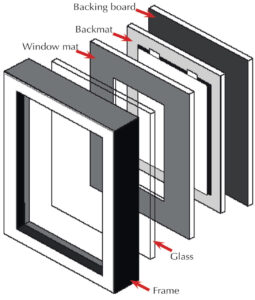 Anatomy of a Frame