


Exhibition dates: 20 February – 5 March 2026
Venue: Mangawhai Artists Gallery, 45 Moir St, Mangawhai.
Artists: Alysn Midgelow-Marsden, Christine den Hartogh, Howard Esler
Step into Residue, a new exhibition of textiles, paper, wire, metal sculpture and photography. Three artists transform fragments, traces and discarded materials into evocative works exploring memory, decay and transformation. Discover the beauty of what remains after time and process leave their mark through the art of Alysn Midgelow-Marsden, Christine den Hartogh and Howard Esler.
‘Residue’, at the popular Mangawhai Artists Gallery (found on Moir St, Mangawhai) from 20th February to the 5 March 2026 invites viewers to look closely at what remains after process and time have left their mark. Combining textile, wire, metal, sculpture, photography, the exhibition offers a layered experience of materials transformed by fire, rust, memory and touch. Visitors are encouraged to explore how each artist reimagines traces and fragments as objects of beauty, curiosity and meaning. The artists are Alysn Midgelow-Marsden, Christine den Hartogh and Howard Esler each of whom will present their distinctly different styles yet creating a cohesive response to the title ‘Residue’.
Alysn’s gilded, and patinated drawings and sculptural forms in wire and metal meshes and cloths are inspired by emotional connections. Christine’s explorations of beach treasures, patterns left in the sand after high tide in photography and botanical and rust printing are woven together with discarded materials into a cohesive whole. Howard presents a ladder sculpture and series of America’s Cup boats reimagined in rusty No8. In addition, each artist has created an exhibition specific work from jointly shared materials and objects, showing the connections though the individual physical practices and conceptual merging as they consider the idea of ‘residue’.
Artist profiles
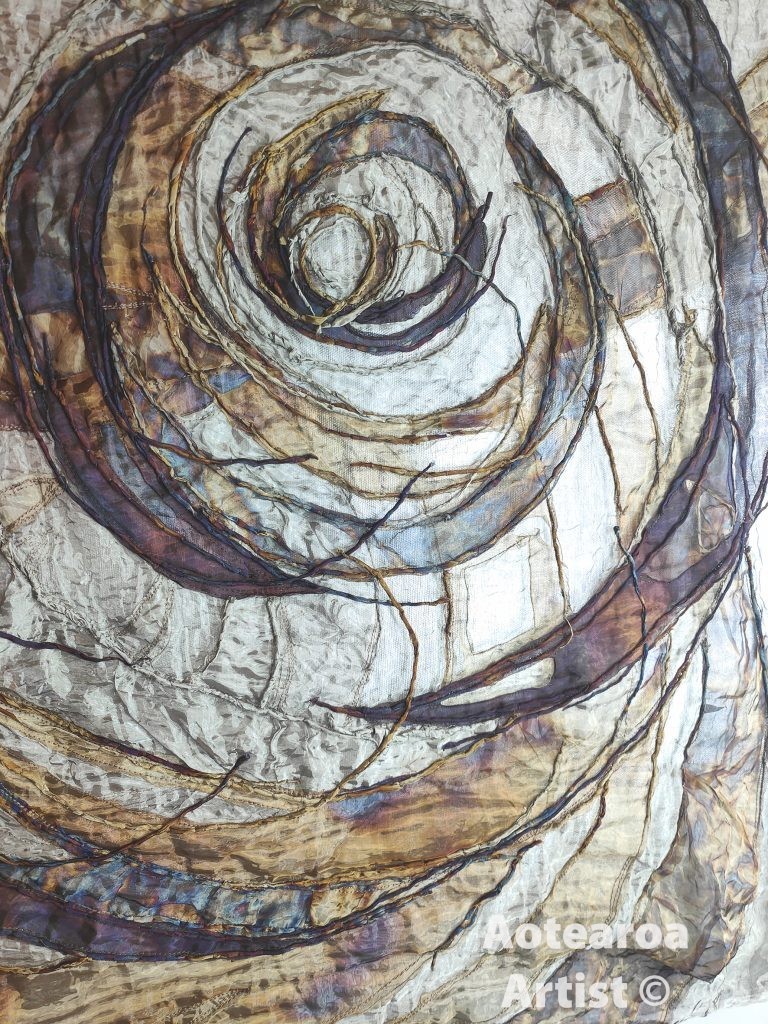
Alysn Midgelow-Marsden has exhibited widely across New Zealand, Australia, the UK and China. Highlights include solo shows Rust and Stardust (Timeless Textiles Gallery, AUS and Easel Gallery, NZ), installations (Fluid Becoming, Silo 6, Auckland, NZ) alongside invitations to landmark group exhibitions such as Vastness and Wings (Timeless Textiles, AUS), The Beach (From Out of the Blue Gallery, NZ), Time (Surface Design Association, NZ), the Estuary Arts and Ecology Award (third prize, 2024), Changing Threads finalist (NZ) over several years and Mandurah Wearable Arts (AUS) finalist. Her work has also featured in major showcases including the Knitting & Stitching Show (UK), Festival of Quilts (UK), Auckland Climate Change Festival and numerous juried or selected exhibitions celebrating contemporary fibre, sculpture and mixed media art.
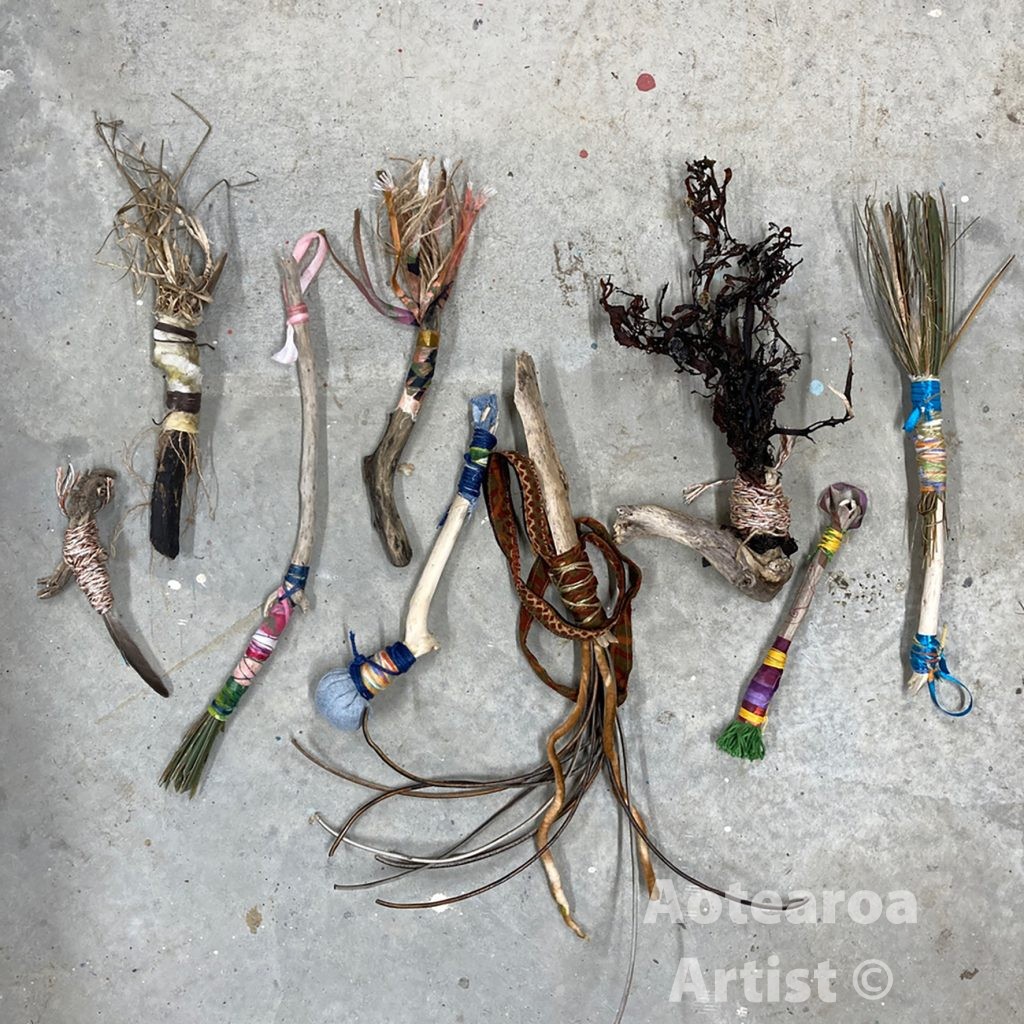
Christine den Hartogh trained in the Netherlands, graduating from the Academy for Photography Amsterdam with a specialisation in photojournalism and documentary photography, the Nederlandse Fotovakschool, and the Willem de Kooning Academy for Art in Rotterdam. After years working in documentary and press photography, she is now based in Northland, where they serve as gallery and exhibition coordinator for Mangawhai Artists Inc. Her recent exhibitions include Art in the Park at Eden Park, Auckland (2025), Philosophy of Light – a duo exhibition at Mangawhai Artists Gallery (2025) – and repeated selections for the prestigious Art Salon at Fo Guang Shan Gallery, Auckland (2018–2025).
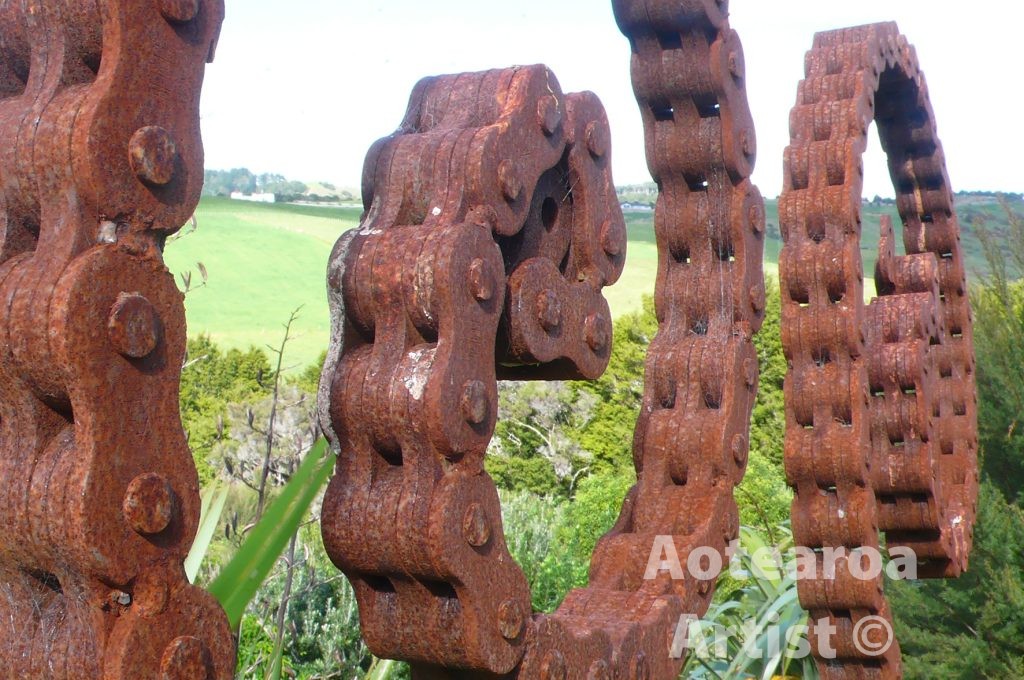
Howard Esler is a retired engineer whose lifelong fascination with the intersection of engineering and art shapes his sculptural practice. Mostly self-taught, he creates large-scale works from discarded and repurposed materials, transforming the residue of other people’s lives into intricate, often monumental pieces. His sculptures, many of which are installed in his own sculpture park, reflect his belief that bridges, mechanisms and machines can possess the same beauty as nature’s designs. He has exhibited at Mangawhai Artists Gallery and also shares his skills through short courses, encouraging others to bring their own concepts to life.
Get to know the artists a little better:
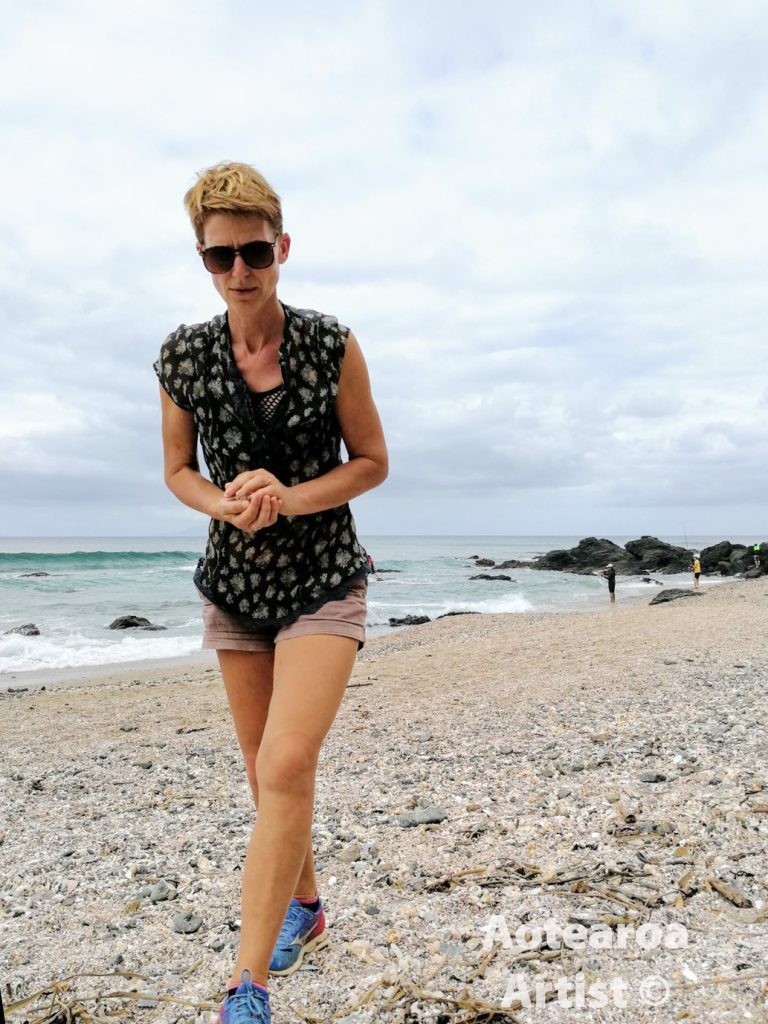
Alysn Midgelow-Marsden’s story
I have a background in both science and art and though they have not always felt in sync they have always overlapped to some extent. I have long used the ‘tarnish of time’ in my work, in fact the first exhibition I ever took part in was called ‘Tarnished’. The oxides such as verdigris and rust which develops as objects are left to begin their journey back to being simple elements, returning to the earth and recognising that losing their previous form is a natural process.
I have always been drawn to textiles and stitch, this may be because it was something I have been familiar with from a young age. When I began to do more art I gravitated to these mediums. I vividly recall the excitement of discovering at school that a domestic sewing machine could stitch in curves and complex shapes and be used as a drawing tool. I feel that I have a curious, experimental nature and use media which are not traditionally considered as textile or thread. I use metal, cloth made of metal, and wire in addition to materials such as concrete, latex, paint and gilding. I also seem to burn and melt things whenever possible (deliberately for the most part) as this also relates to exploring the nature of a material.
Residue is such an evocative and inspiring title for this exhibition. The images, metaphors, and allegories which it sparked have been a joy. It is a word with physical interpretations such as the actual residue, leavings, traces of something as well as speaking about what effects are left behind when something is gone, an emotional residue. I am working on a series which is based on the phrase ‘we live suspended by fine threads’, linking the idea that we are tied with fine, possibly invisible, possibly unconscious threads to ourselves, to others, to the universe etc. but that equally, nothing remains constant and everything can change in an instant so that we should celebrate and be grateful for what we have and are.
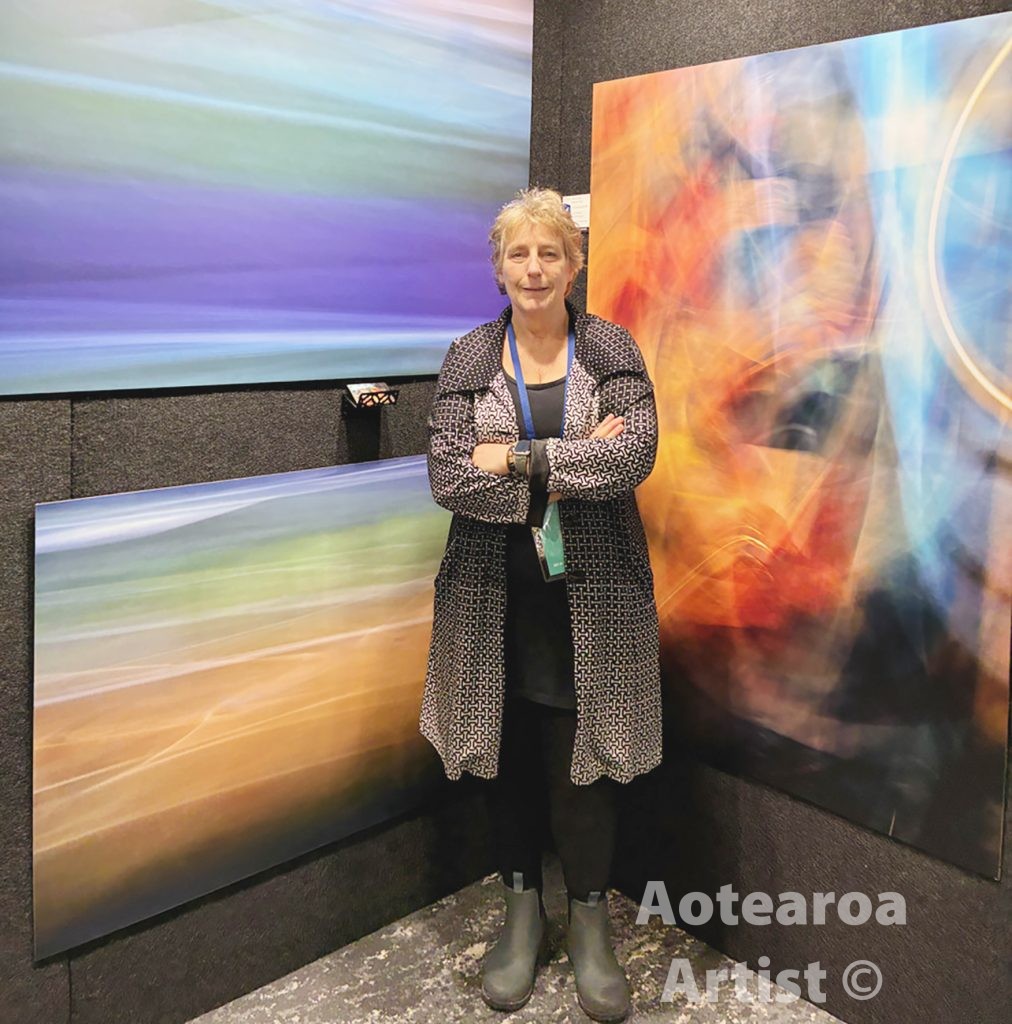
Christine den Hartogh’s story
I am an artistic explorer.
From the lively art scene of the Netherlands to the stunning landscapes of New Zealand, my creative journey has been one of growth and discovery.
After several years immersed in black-and-white documentary photography and photojournalism in the Netherlands, working with my beloved Nikon F3, a 24 mm lens and grainy black and white film, my creative path took a turn when I arrived in Aotearoa. Here, I began to explore other forms of image-making: monoprinting, cyanotype, rust printing, botanical printing—drawn to their tactile qualities and slow, intuitive processes. I also have my eye on ceramics as a new art form to explore.
‘Residue’, the title of our exhibition opens up many possible directions for me. I’ve been gathering beach treasures left behind by the ocean, exploring the patterns left in the sand after high tide, testing out botanical prints and rust printing, and plan to also use discarded materials. My aim is to weave these elements together into a cohesive whole, though the work is still evolving and I’m curious to see which direction it ultimately takes me.
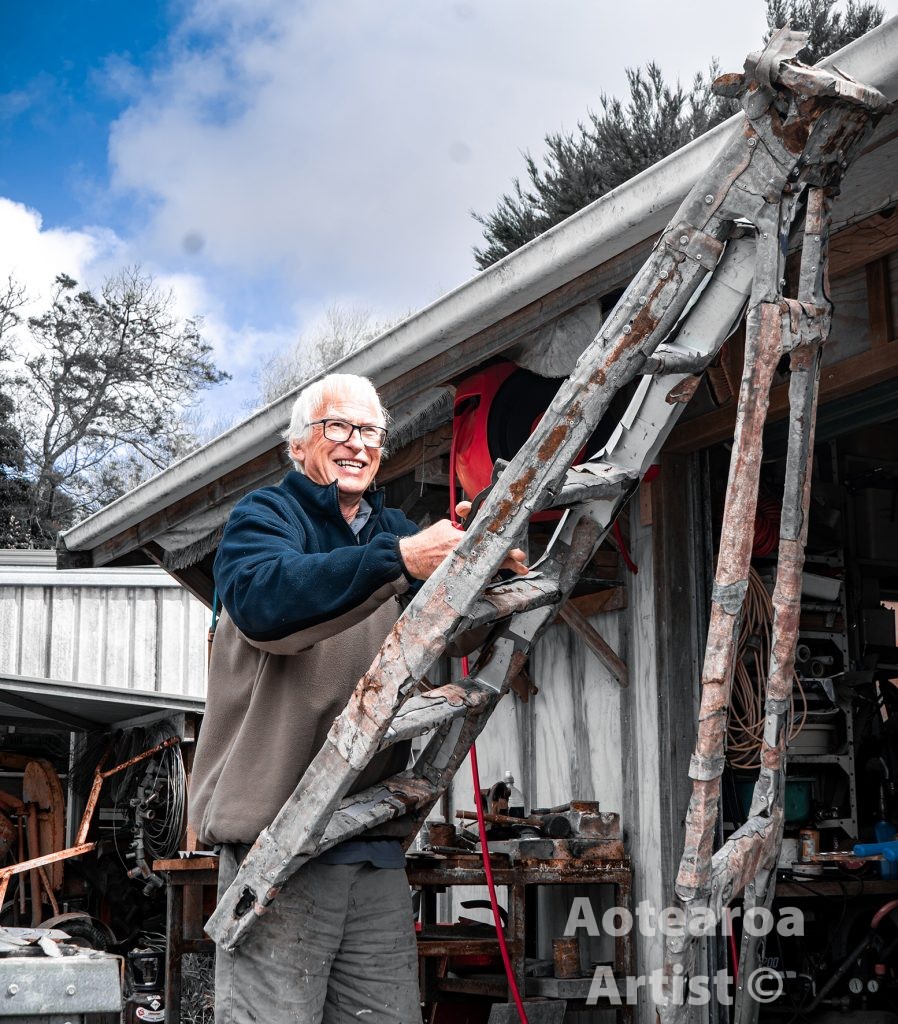
Howard Esler’s story
My name is Howard Esler. I am a retired engineer. I have always regarded art and engineering as close companions. There is much in life to keep the mind alive after retirement. Nature, history, literature, architecture, politics, engineering and of course ART
I have been making sculptures from discarded materials since I was a kid – the residue of other people’s lives. Rusty steel is like no other discarded metal. It can be shaped with hammers, grinders, flames, chisels, shears, saws and more. It can be melted with simple equipment and joined with many welding techniques. It is free and abundant and ranges from jewellery scale to a size limited only by the available equipment. It combines beautifully with glass, ceramics, other metals and wood. Best of all is the rust itself which changes appearance with time, the weather and the light. A rusty steel sculpture will have its life in years, almost like a living thing, before decaying into a pile of red brown flakes.
I am mostly self-taught and now pass my skills to others in short courses. Most of my sculptures are scattered around my own sculpture park as most are not easily moved. I enjoy working alongside people to make their own concepts come alive.
The results of an engineering project should always be a work of art. Consider a Roman stone arched bridge, or the soaring steel beauty of Golden Gate and the pedestrian bridges some far sighted engineer designed to cross Auckland’s motorways. An intricate mechanism for a machine or a motorway interchange viewed from the sky are similarly works of art – or should be. Look at the beauty of a circuit board for a computer and if we dive in orders of magnitude smaller, a similar beauty lies under the electron microscope when we view the millions of transistors etched on a chip of silicon.
For the Residue exhibition my work will mostly feature rust. I have nearly completed a sculpture made from an old and unsafe, 6 foot, wooden step ladder. This stands on one leg only out of 4 and is covered in small pieces of corrugated iron rivetted together. I have pit fired it to burn out the ladder – residue of residue! I am working on a small series of America’s Cup boats reimagined in rusty No8. I am getting quite excited about these.
Exhibition details:
Opening Event: 20 February 2025. 6.00 -7.30pm
Open 21 February – 5 March. Open daily 10.30am -3.30pm, Saturdays 9am -3.30pm, final day open until 12.30pm
Artist contact details:
Alysn Midgelow-Marsden:
w: www.alysnmidgelowmarsden.com; e: alysnmm@gmail.com; i: @alysnmmart
Christine den Hartogh:
w: www.chrissieseye.com; e: chris@chrissieseye.com; i: @chrissieseye
Howard Esler:
e: howardesler@gmail.com
Gallery contact details:
Mangawhai Artists Gallery
www.mangawhaiartists.org
gallery@mangawhaiartists.co.nz
45 Moir Street, Mangawhai
Comments (0)